At a glance
- ✓Healthcare SEO in 2026 is governed by E-E-A-T — Google holds medical content to the highest trust standards due to YMYL classification.
- ✓AI search engines like Google AI Overviews and Perplexity prioritize Answer-First content — structure your pages to answer questions in the first sentence.
- ✓Local SEO and hyper-local topic clusters remain the highest ROI patient acquisition channel for clinics.
- ✓FAQ schema and structured content dramatically increase the chance of being cited in AI-generated answers.
For clinic owners
Want this implemented for your practice — not just as a guide? Single-location clinic projects start at $800 — final investment confirmed after a 15-minute audit.
See Healthcare SEOQuick answer: A healthcare SEO strategy that drives patient bookings in 2026 comes down to four pillars: (1) local search fundamentals (GBP + location pages), (2) medical schema and entity clarity, (3) treatment/topic clusters with answer-first formatting for AI Overviews, and (4) trust signals (reviews, credentials, outcomes). If you want help implementing this, start with our healthcare SEO services or book a free strategy call.
What is Healthcare SEO?
Healthcare SEO is the process of optimizing a medical practice's digital infrastructure and content to rank for high-intent search queries. According to 2026 research, 48.75% of healthcare searches trigger AI-synthesized summaries. To rank, practices must maintain complete HIPAA compliance, structure data cleanly using Schema.org, and secure authentic E-E-A-T signals.
Healthcare SEO in 2026 is fundamentally different from general SEO. Your patients search differently, your content needs medical accuracy, and your competition is hyperlocal. Implementing a proper healthcare SEO strategy is essential, as SEO for health and wellness business requires specialized knowledge that generalist agencies lack. As a healthcare web design agency, we've helped med spas, IV therapy clinics, and ketamine centers build patient acquisition systems powered by organic search. Whether you need SEO for medical clinics or a multi-location practice, this guide covers everything you need to know about ranking on Google and acquiring patients organically.
At Marceline Studios, we've seen firsthand how the right healthcare SEO strategy transforms a clinic's online presence. When we started working with DripGym — a US-based IV therapy and med spa clinic — their website was practically invisible on Google. After implementing the exact strategies outlined in this guide, their treatment-specific pages started capturing long-tail search traffic and driving real patient bookings. Whether you run a medical practice, med spa, or wellness clinic, this healthcare digital marketing playbook will show you exactly how to do the same.
What Is Healthcare SEO? (And Why It's Different)
Healthcare SEO is the practice of optimizing medical practice websites to rank higher in Google search results and attract more patients organically. Unlike general SEO, healthcare SEO operates under strict YMYL (Your Money or Your Life) guidelines, requires E-E-A-T signals from qualified authors, and must account for hyperlocal search intent — since over 80% of patients search for healthcare providers within their own city or neighborhood.
For med spas, IV therapy clinics, ketamine centers, and functional medicine practices, a strong healthcare SEO strategy is the difference between a fully booked schedule and an empty waiting room.
Integrating EMR Portals Without Triggering HIPAA Violations
Connecting patient-facing portals to Athenahealth, Epic MyChart, Jane App, or Aesthetic Record requires more than a login button. HIPAA violations often occur when marketing sites pass PHI through unsecured form plugins, store session tokens in browser localStorage, or embed third-party widgets that leak referrer data.
Safe integration principles:
- Keep marketing analytics separate from clinical data flows — never send PHI to GA4 or Meta Pixel
- Use server-side OAuth handoffs for EMR scheduling — not iframe embeds with patient identifiers in URL params
- Audit every third-party script quarterly — many "HIPAA compliant" badges on WordPress plugins are marketing claims, not BAAs
- Route intake forms through encrypted endpoints with role-based access and audit logging
California CPOM Compliance in Healthcare Web Design
The Corporate Practice of Medicine (CPOM) doctrine affects how clinics present ownership, medical supervision, and treatment claims on their websites — especially in California, Texas, and New York. Your site architecture must reflect who employs physicians, who owns the MSO, and how medical decisions are supervised.
Web design implications:
- Medical director credentials and supervision statements must be visible on treatment pages — not buried in footer legal text
- MSO vs. clinical entity branding must be clearly separated in schema markup (Organization vs. MedicalBusiness)
- Avoid implying that non-physician staff perform medical procedures without physician oversight language
- Location pages for California markets should reference state-specific advertising rules for aesthetic and wellness treatments
Why Healthcare SEO Is Different
Healthcare SEO operates under unique constraints and opportunities that set it apart from every other industry:
YMYL (Your Money or Your Life): Google classifies health-related content as YMYL, meaning it applies stricter quality standards. Your content needs to demonstrate E-E-A-T (Experience, Expertise, Authoritativeness, Trustworthiness) to rank. This is why partnering with a healthcare web design agency that understands these requirements matters. In practice, this means every page on your medical practice website needs author credentials, cited sources, and medically accurate information — or Google will suppress it in favor of competitors who provide these trust signals.
Local intent dominance: Over 80% of healthcare searches have local intent (Source: Think with Google, 2025). Patients search for "doctor near me," "best dentist in [city]," or "[treatment] in [neighborhood]." Your medical practice SEO strategy must be built around local search — especially for med spas, IV therapy clinics, and wellness practices. For example, "Botox near me" generates over 110,000 monthly searches in the US alone (Source: Ahrefs, 2025). If you run a New York med spa or clinic, capturing those local searchers means capturing patients who are ready to book within days.
Compliance requirements: Healthcare content must be medically accurate and compliant with advertising regulations. You can't make unsubstantiated claims, and patient testimonials need proper disclaimers. A HIPAA compliant website is table stakes for any serious healthcare practice. The FTC has increased enforcement against misleading health claims, making compliance not just an ethical obligation but a legal one.
Patient search behavior: Healthcare patients search differently than typical consumers. They research symptoms, compare providers, read reviews, and often visit 3-5 websites before booking. Your patient acquisition SEO strategy needs to capture them at every stage — from "what is NAD+ therapy" (awareness) to "best IV therapy clinic in Manhattan" (decision). Understanding this journey is core to effective clinic local SEO.
The Healthcare SEO Framework
1. Local SEO Foundation
For most healthcare practices, clinic local SEO is the single highest-ROI activity. At Marceline Studios, we've seen practices generate 30-50 new patient inquiries per month from local search alone — and when you're ready for hands-on healthcare SEO services, we implement the same checklist below. Here's the complete local SEO checklist:
Google Business Profile (GBP):
- Claim and verify your GBP for each location
- Complete every field: services, attributes, business description, hours
- Add high-quality photos of your facility, staff, and treatments (profiles with 100+ photos get 520% more calls than average — Source: BrightLocal, 2025)
- Post weekly updates about services, tips, or practice news
- Respond to every review within 24 hours (positive and negative)
- Add your appointment booking link directly to your GBP
- Use the Q&A feature to proactively answer common patient questions
✅ Local SEO Quick-Start Checklist:
- Google Business Profile claimed, verified, and 100% complete
- NAP (Name, Address, Phone) identical across all 20+ directories
- At least 10 high-quality facility photos uploaded to GBP
- Weekly GBP posts scheduled for the next 4 weeks
- Review response template created for positive and negative reviews
- Location page created with embedded Google Maps and LocalBusiness schema
- Top 5 healthcare directories (Healthgrades, Vitals, WebMD, Zocdoc, Yelp) claimed and updated
NAP Consistency:
- Ensure your Name, Address, and Phone number are identical across every online listing
- Audit major directories: Yelp, Healthgrades, Vitals, WebMD, Zocdoc, Yellow Pages
- Fix any inconsistencies — even small variations (St. vs Street, Suite vs Ste.) confuse Google
- Use a citation management tool like BrightLocal or Yext to monitor and fix issues automatically
Location Pages:
- Create a unique page for each location you serve
- Include embedded Google Maps, driving directions, parking information
- Feature location-specific staff bios and patient testimonials
- Add LocalBusiness schema with precise geo-coordinates
- Target "[service] in [city/neighborhood]" keywords
- Include nearby landmarks and neighborhood references for hyperlocal relevance
Real Example: When we optimized DripGym's local SEO presence, we ensured their Google Business Profile was fully built out with treatment-specific services, provider photos, and weekly posts about their IV therapy and wellness offerings. This kind of clinic local SEO groundwork is what separates practices on page 1 from those buried on page 7.
Adapting to AI Search & Generative Engine Optimization (GEO)
In 2026, patients increasingly use AI tools like ChatGPT, Perplexity, and Google AI Overviews to find healthcare providers before ever visiting a website. This shift means your content strategy must evolve beyond traditional SEO.
Generative Engine Optimization (GEO) is the practice of structuring content so AI systems can easily extract, summarize, and cite it in their responses. For healthcare practices, this means:
Answer-First formatting: Every H2 section should begin with a direct, 2-sentence answer to the question implied by the heading. AI engines scrape these direct answers first.
FAQ schema implementation: FAQ sections with proper schema markup are the most commonly cited sources in Google AI Overviews. Every healthcare page should include an FAQ section targeting the exact questions patients ask.
Structured data breadth: Practices with comprehensive schema markup — MedicalBusiness, LocalBusiness, FAQPage, Service — appear more frequently in AI-generated healthcare summaries.
Entity authority: Build topical authority by covering your niche comprehensively. AI systems prefer sources that demonstrate deep expertise in a specific domain over generalist sites.
2. Content Strategy for Healthcare
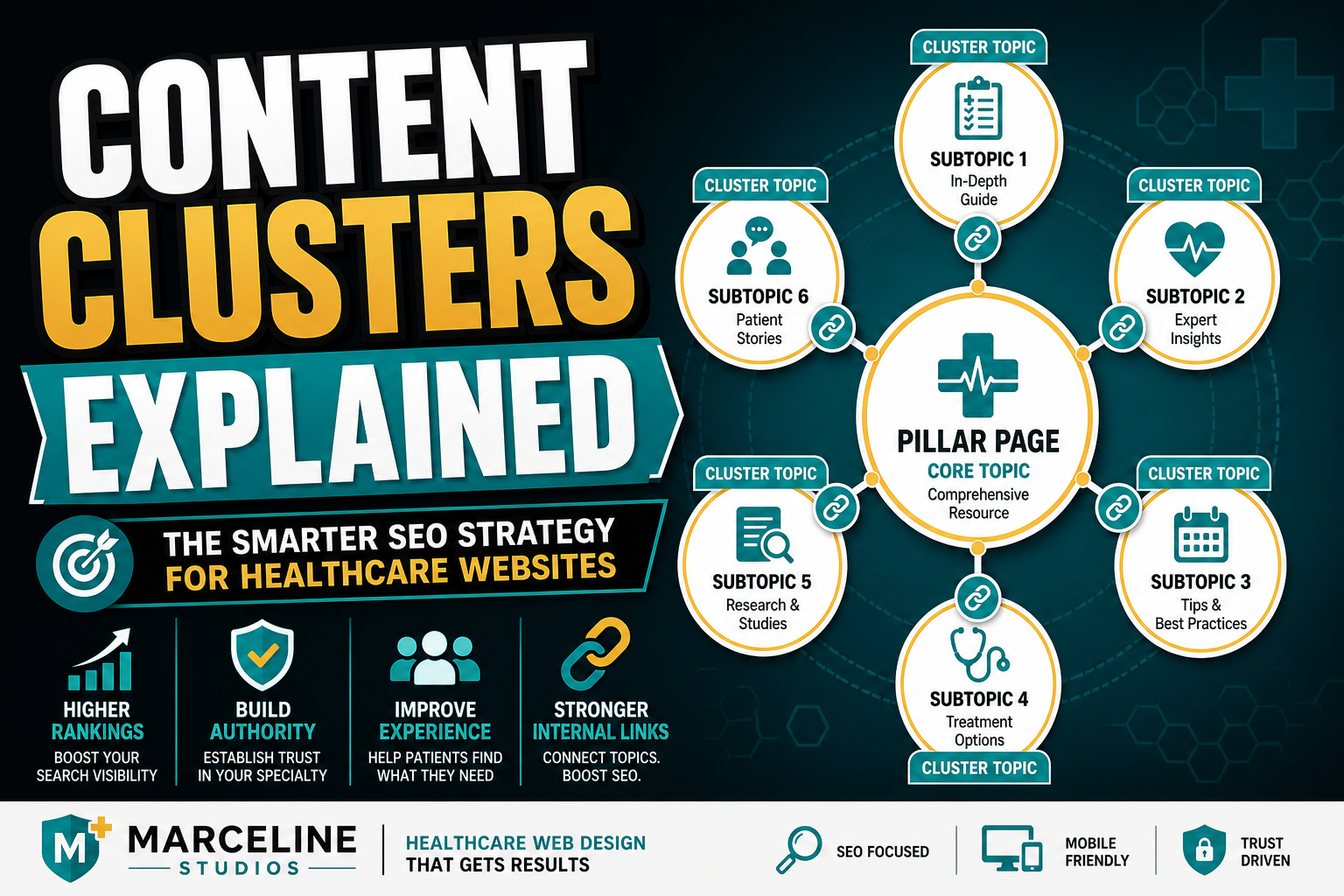
Your content strategy should be built around topic clusters — a core principle of healthcare digital marketing:
Pillar pages: Comprehensive guides targeting your primary service keywords (e.g., "Botox Treatment Guide," "IV Therapy: Everything You Need to Know"). These should be 2,000-3,000 words, covering every angle a patient might search for. At Marceline Studios, we've seen pillar pages generate 3-5x more organic traffic than standard service pages.
Supporting blog posts: Articles targeting long-tail questions your patients ask (e.g., "How long does Botox last?," "Is IV therapy safe?," "What to expect during ketamine treatment"). Each supporting post should be 1,000-1,500 words and link back to the relevant pillar page.
Internal linking: Every blog post should link to the relevant pillar page, and pillar pages should link to supporting content. This builds topical authority that Google rewards. Our clients at Marceline Studios typically see a 40-60% increase in organic traffic within 6 months of implementing a proper topic cluster strategy. For a deeper look at how we structure healthcare SEO services, check out our dedicated service page.
Content calendar example for a med spa:
- Week 1: "What Is Microneedling? Benefits, Process, and Recovery" (supporting post)
- Week 2: "Botox vs. Fillers: Which Is Right for You?" (supporting post)
- Week 3: "Complete Guide to Med Spa Treatments in [City]" (pillar page update)
- Week 4: "How to Choose the Best Med Spa Near You" (supporting post)
✅ Content Strategy Checklist:
- Identify 3-5 pillar topics based on your highest-revenue treatments
- Map 5-10 supporting blog post ideas for each pillar topic
- Create an internal linking plan connecting supporting posts to pillar pages
- Establish a monthly content calendar with at least 2 new posts per month
- Assign medical review to a licensed provider for every clinical content piece
- Set up content performance tracking in Google Search Console
3. Schema Markup for Healthcare
Schema markup is non-negotiable for healthcare practices in 2026. It makes your content machine-readable and eligible for rich results. As a healthcare web design agency, we recommend implementing schema from day one:
Essential schemas:
- MedicalBusiness or Physician — Your practice type, specializations, and credentials
- LocalBusiness — Location data with geo-coordinates for each location
- Service — Individual services with descriptions and pricing
- FAQPage — Treatment FAQs that appear directly in search results
- Review/AggregateRating — Patient reviews for star ratings in search
- BreadcrumbList — Navigation hierarchy for better search appearance
- MedicalWebPage — Signals to Google that your page contains medical content reviewed by a qualified professional
Real Example: For DripGym's 12+ treatment landing pages, we implemented Service schema on every page with treatment names, descriptions, and price ranges. We also added FAQPage schema to surface their treatment-specific questions directly in Google search results. This kind of structured data implementation is a hallmark of effective medical practice SEO — it gives Google the context it needs to display your practice in rich results, knowledge panels, and featured snippets.
✅ Schema Implementation Checklist:
- MedicalBusiness or Physician schema on your homepage
- LocalBusiness schema on every location page with geo-coordinates
- Service schema on every treatment/service page
- FAQPage schema on pages with FAQ sections
- Review/AggregateRating schema connected to your review profiles
- BreadcrumbList schema for navigation hierarchy
- Test all schema with Google's Rich Results Test tool
4. Technical SEO for Healthcare Websites
Core Web Vitals: Google measures your website's loading speed (LCP), interactivity (INP), and visual stability (CLS). Healthcare websites often fail these metrics due to heavy imagery, unoptimized booking widgets, and third-party scripts. At Marceline Studios, we build on Next.js with automatic image optimization and edge caching to ensure our healthcare clients consistently pass Core Web Vitals — a critical component of functional medicine web design and wellness practice digital marketing alike.
Specific benchmarks your medical practice website should hit:
- LCP (Largest Contentful Paint): Under 2.5 seconds
- INP (Interaction to Next Paint): Under 200 milliseconds
- CLS (Cumulative Layout Shift): Under 0.1
- Time to First Byte (TTFB): Under 800 milliseconds
Mobile optimization: Over 70% of healthcare searches happen on mobile. Your website must be mobile-first, fast, and easy to navigate with touch. This means thumb-friendly buttons (minimum 48x48px tap targets), readable font sizes without zooming, and streamlined booking flows that work on a 5-inch screen.
Security & compliance: HTTPS is mandatory. Consider additional security headers (CSP, HSTS) and ensure form data is handled in a HIPAA-aware manner if collecting patient information. Every HIPAA compliant website should encrypt form submissions and limit data retention.
✅ Technical SEO Checklist:
- All Core Web Vitals passing in Google PageSpeed Insights (mobile)
- HTTPS enabled with valid SSL certificate
- Mobile-first responsive design tested on 3+ device sizes
- XML sitemap submitted to Google Search Console
- Robots.txt properly configured
- No broken links or 404 errors (check monthly)
- Image optimization: WebP format, lazy loading, descriptive alt text
- Page speed under 3 seconds on mobile (3G connection)
5. Measuring Healthcare SEO Success
Track these KPIs monthly:
- Organic traffic — Total visitors from search engines
- Local pack visibility — Rankings in Google's Map Pack for target keywords
- Keyword rankings — Position tracking for primary treatment and location keywords
- Organic conversions — Form submissions, phone calls, and bookings from organic traffic
- Page authority — Domain and page authority growth over time
- Click-through rate (CTR) — How often searchers click your listing vs. competitors
- Cost per acquisition comparison — Compare organic patient acquisition cost vs. paid ads
Setting realistic benchmarks: At Marceline Studios, we've seen that the average healthcare practice should aim for 15-25% month-over-month organic traffic growth in the first 6 months of a new SEO campaign. After 12 months, organic search should be driving 30-50% of all new patient inquiries for a well-optimized practice.
Healthcare SEO Mistakes to Avoid
After working with dozens of healthcare practices, we've identified the most common medical practice SEO mistakes that keep clinics stuck on page 5+:
1. Ignoring local SEO in favor of national rankings. A dermatology practice in Miami doesn't need to rank nationally for "best dermatologist." They need to own "dermatologist in Miami" and "skin doctor near me" for Miami-area searchers. Too many practices chase vanity keywords instead of focusing on clinic local SEO that drives actual bookings.
2. Publishing thin, generic content. A 300-word page about "Our Botox Services" won't rank in 2026. Google expects comprehensive, expert-level content for YMYL topics. At Marceline Studios, we've seen practices jump 20+ positions simply by expanding thin service pages into 1,500-2,000 word comprehensive guides with FAQs, process explanations, and provider credentials.
3. Neglecting Google Business Profile. Your GBP is often the first thing patients see. Practices that don't post weekly, respond to reviews, or update their service listings are handing visibility to competitors who do.
4. No schema markup. Without structured data, Google has to guess what your pages are about. Schema markup removes the guesswork and makes you eligible for rich results that dramatically increase click-through rates.
5. Duplicate content across treatment pages. Copying the same boilerplate text across multiple treatment pages with only the treatment name changed is a recipe for ranking penalties. Each page needs unique, treatment-specific content.
6. Ignoring patient reviews. Reviews are a direct ranking factor for local SEO. Practices that don't actively generate and respond to reviews are leaving one of the most powerful ranking signals untapped. At Marceline Studios, we've seen practices increase their Map Pack visibility by 40% simply by implementing a consistent review generation strategy.
7. Not tracking conversions. If you can't attribute new patient bookings to specific pages, keywords, or channels, you can't optimize your patient acquisition SEO strategy. Set up proper conversion tracking from day one.
Healthcare SEO Tools We Recommend
Based on our experience building healthcare digital marketing strategies for clinics across the US, here are the tools we use and recommend:
For keyword research and tracking:
- Ahrefs — Best for competitive analysis, keyword research, and backlink monitoring. We use it for every medical practice SEO campaign at Marceline Studios.
- Google Search Console — Free, essential, and the most accurate source of your actual search performance data. Check it weekly.
- SEMrush — Excellent for position tracking and local SEO audits. Their Medical & Health category filters are particularly useful.
For local SEO:
- BrightLocal — Best-in-class for citation management, local rank tracking, and review monitoring. Essential for clinic local SEO.
- Google Business Profile — Free and non-negotiable. Your most important local SEO tool.
- Whitespark — Great for finding citation opportunities specific to your healthcare niche.
For technical SEO:
- Google PageSpeed Insights — Monitor Core Web Vitals and get specific optimization recommendations.
- Screaming Frog — Crawl your site to find broken links, duplicate content, and technical issues.
- Schema Markup Validator — Test your structured data implementation before deploying.
For content:
- Clearscope or SurferSEO — Optimize content for topical coverage and competitive content scoring.
- Google's Natural Language API — Understand how Google interprets your healthcare content.
- AnswerThePublic — Find the exact questions patients are searching for about your treatments.
For analytics and conversion tracking:
- Google Analytics 4 (GA4) — Track traffic, user behavior, and conversion events.
- CallRail — Track phone calls back to specific pages and keywords. Critical for healthcare practices where phone bookings are common.
- Hotjar — Heatmaps and session recordings to understand how patients interact with your site.
How Long Does Healthcare SEO Take? (Real Timeline)
This is the question every practice owner asks, and we believe in setting realistic expectations. Here's the real timeline we've observed across our healthcare clients at Marceline Studios:
Month 1-2: Foundation & Setup
- Technical SEO audit and fixes
- Google Business Profile optimization
- Schema markup implementation
- Keyword research and content strategy planning
- Citation building begins
- Expected results: Minimal ranking changes. Google is discovering and indexing your optimizations.
Month 3-4: Early Traction
- First content pieces published and indexed
- Citation building continues
- Review generation strategy implemented
- Local SEO signals strengthening
- Expected results: Long-tail keywords start moving. You may see treatment-specific pages enter the top 50-30 positions. Clinic local SEO improvements become visible in GBP insights.
Month 5-6: Momentum Building
- Content library growing (8-12 published pieces)
- Internal linking structure solidifying
- Reviews accumulating
- Backlink profile strengthening
- Expected results: Noticeable organic traffic increase (typically 30-60% over baseline). Some treatment keywords entering page 2-3. Map Pack visibility improving for location-specific searches.
Month 7-12: Compounding Growth
- Consistent content publication
- Topical authority established in your niche
- Strong review profile built
- Technical health maintained
- Expected results: Top 10 rankings for multiple treatment and location keywords. Organic traffic becomes a significant patient acquisition channel. ROI from SEO exceeds paid advertising for many practices.
Real Example: When we built DripGym's treatment-specific landing pages, they started capturing long-tail search traffic within the first 2-3 months. By month 6, treatment pages for NAD+ therapy, IV vitamin infusions, and ketamine were ranking for dozens of relevant keywords. The key was creating 12+ dedicated pages — each targeting specific patient search queries — rather than cramming everything onto a single services page. This is the kind of patient acquisition SEO strategy that compounds over time.
The honest truth: Healthcare SEO is not a quick fix. If anyone promises you page 1 rankings in 30 days for competitive medical keywords, they're either lying or using tactics that will get your site penalized. Real, sustainable medical practice SEO takes 6-12 months to deliver meaningful ROI — but the results compound year over year, making it the most cost-effective healthcare digital marketing channel long-term.
Getting Started
Healthcare SEO is a long-term investment that sits at the heart of effective wellness practice digital marketing. Most practices see meaningful results within 3-6 months of consistent effort. The key is starting with a solid foundation — local SEO, proper schema markup, and treatment-specific content — and building from there.
Whether you're a med spa looking to improve your website design, a clinic that needs comprehensive healthcare SEO services, or a practice inspired by results like our DripGym case study, the framework in this guide will help you build a patient acquisition system powered by organic search. For budget and build options, pair this guide with our med spa website cost guide and med spa design tips.
If you need help implementing a healthcare SEO strategy for your practice, book a free strategy call with our healthcare digital marketing agency team.
Frequently asked questions
Healthcare SEO is the process of optimizing a medical practice website to rank higher on Google for health-related searches. It includes local SEO, schema markup, E-E-A-T content signals, and keyword optimization specific to medical and wellness practices.
Most healthcare practices see initial ranking improvements within 3-6 months of implementing a consistent SEO strategy. Local SEO results — like Google Maps Pack rankings — often appear faster, within 4-8 weeks of optimization.
Yes — healthcare SEO delivers some of the highest ROI of any marketing channel for medical practices. Unlike paid ads that stop when you stop paying, organic rankings compound over time and continue driving patient bookings months and years after the initial work.
Healthcare SEO operates under YMYL (Your Money or Your Life) guidelines requiring stricter E-E-A-T standards. Content needs medical accuracy, local intent dominates, and compliance requirements apply. Additionally, patient acquisition SEO involves unique conversion paths — patients research providers, read reviews, and often call before booking.
Essential schemas include MedicalBusiness or Physician, LocalBusiness with geo-coordinates, Service for individual treatments, FAQPage for rich results, and Review/AggregateRating for star ratings in search.
Healthcare SEO retainers typically range scoped after your live auditnth depending on competition, number of locations, and scope. At Marceline Studios, our packages are designed to be accessible for growing practices while delivering measurable ROI. Most practices recoup their investment within 4-6 months through increased organic patient bookings.
You can handle some aspects yourself — Google Business Profile optimization, review generation, and basic content creation. However, technical SEO, schema markup, competitive keyword strategy, and ongoing optimization typically require specialized expertise from a healthcare web design agency.
Healthcare SEO typically delivers 3-5x better long-term ROI compared to Google Ads for patient acquisition. While paid ads stop generating leads when you stop paying, SEO results compound over time. The best strategies combine both SEO and paid advertising.